I took Interact to 7,000 users in college. Then I shut it down.
Three years, four full rebuilds, one very chaotic hackathon deployment, and what I actually learned from building something that a lot of people used and I still chose to walk away from.
February 2025. Interact had just come off its biggest week ever. Yantra'25, VIT's largest technical fest, had run entirely on the platform. 40+ events, 50+ volunteers coordinated across the college, 7,000 active users making projects, joining organisations, finding collaborators. My university had started early conversations about using Interact as the official platform for research collaborations between professors and students. Things were not just working. They were flourishing.
I shut it down two months later. Not because it failed. Not because something broke. But because I had been honest with myself about what Interact was, what it wasn't, and what it was never going to be. And that honesty, as uncomfortable as it was, pointed clearly in one direction.
This is the story of three years, four full rebuilds, one very chaotic hackathon deployment, and what I actually learned from building something that a lot of people used and I still chose to walk away from.
The origin
Interact did not start with a vision. It started with frustration.
I was a backend developer. Every project I wanted to build needed a designer, a frontend person, someone to fill the gaps I could not. I was in the Computer Society of India (CSI), reasonably well connected by college standards, and even then finding the right person meant going through my contacts one by one, asking around manually, and hoping someone was both interested and not already buried in something else. It took time, most leads went nowhere, and I was one of the lucky ones with a network to tap into at all. That last part bothered me more than my own inconvenience. If it was this hard for me, it was significantly worse for everyone else. A first year student with a project idea and no existing connections had essentially no way to find collaborators within their own college. LinkedIn was too noisy and too professional. Twitter was not built for this. Your college network existed but had no infrastructure. You either knew the right people already or you did not find them at all.
That was the gap. Simple, unglamorous, and real.
Building in the dark
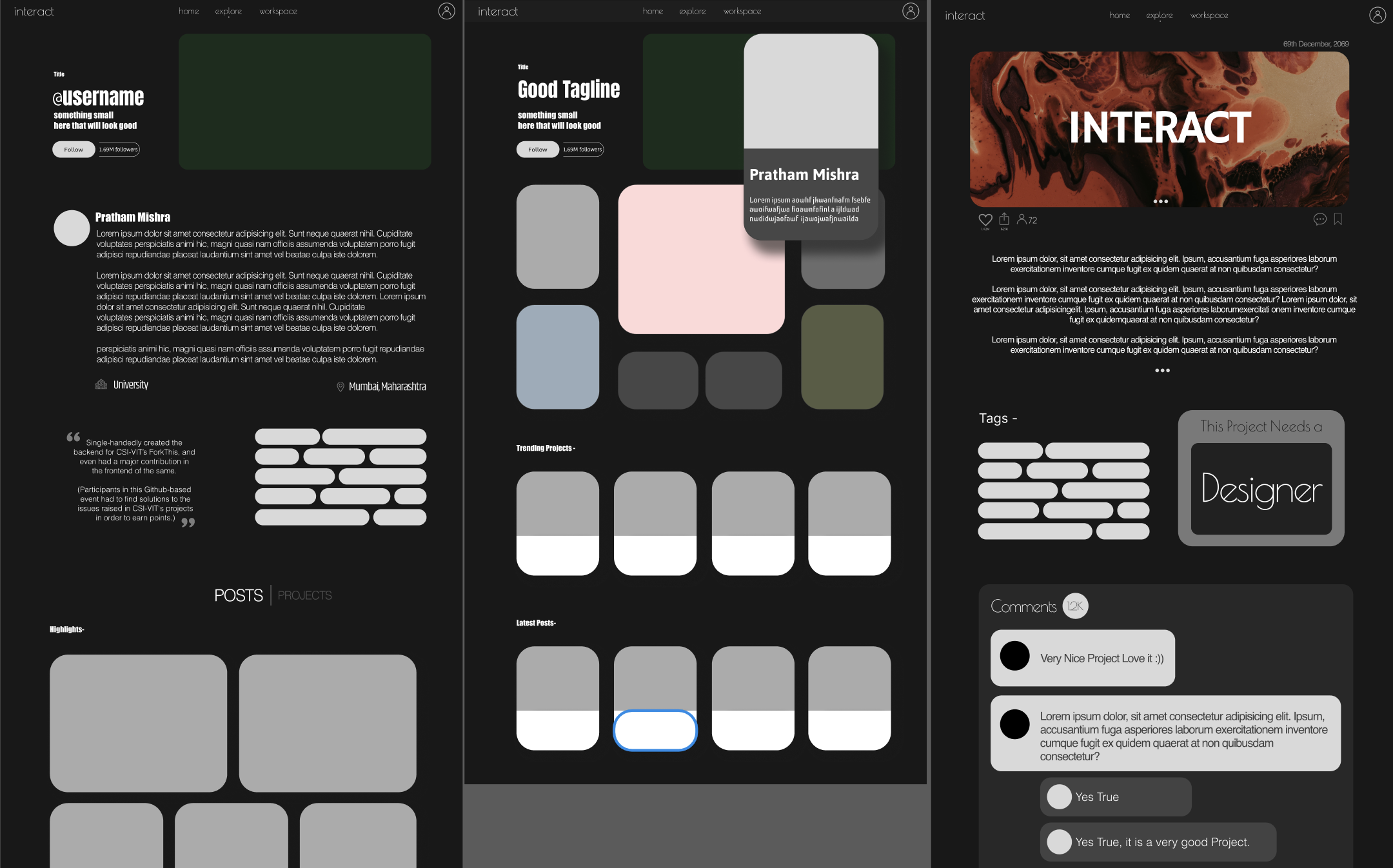 Interact V1 Figma designs - the first attempt at giving the idea a visual form
V1 started the way most honest college projects do: with the tools you already knew. React on the frontend, Express on the backend, MongoDB for the database. I was a second year student and I built what I could with what I had. The core was simple: post a project, add openings, let people apply, approve or reject them. A place to find people. That was it.
But I was not a designer and I knew it. I taught myself Figma, took a first pass at the UI, and quickly realised the gap between what I had imagined and what I had actually made was significant. A senior designer from college helped me see it clearly and I revamped the entire frontend. It looked better. The idea was still the same though: find people, that is all.
Then I got into the product and realised the obvious thing I had missed. Finding people was only half the problem. What happened after someone joined your project? There was nowhere to go. No way to track tasks, assign work, link a GitHub PR to a ticket, manage who could do what inside a project. So I built that too. Custom RBAC, task tracking, Figma and GitHub integrations inside tickets. Interact was no longer just a place to find collaborators. It was where you actually worked with them.
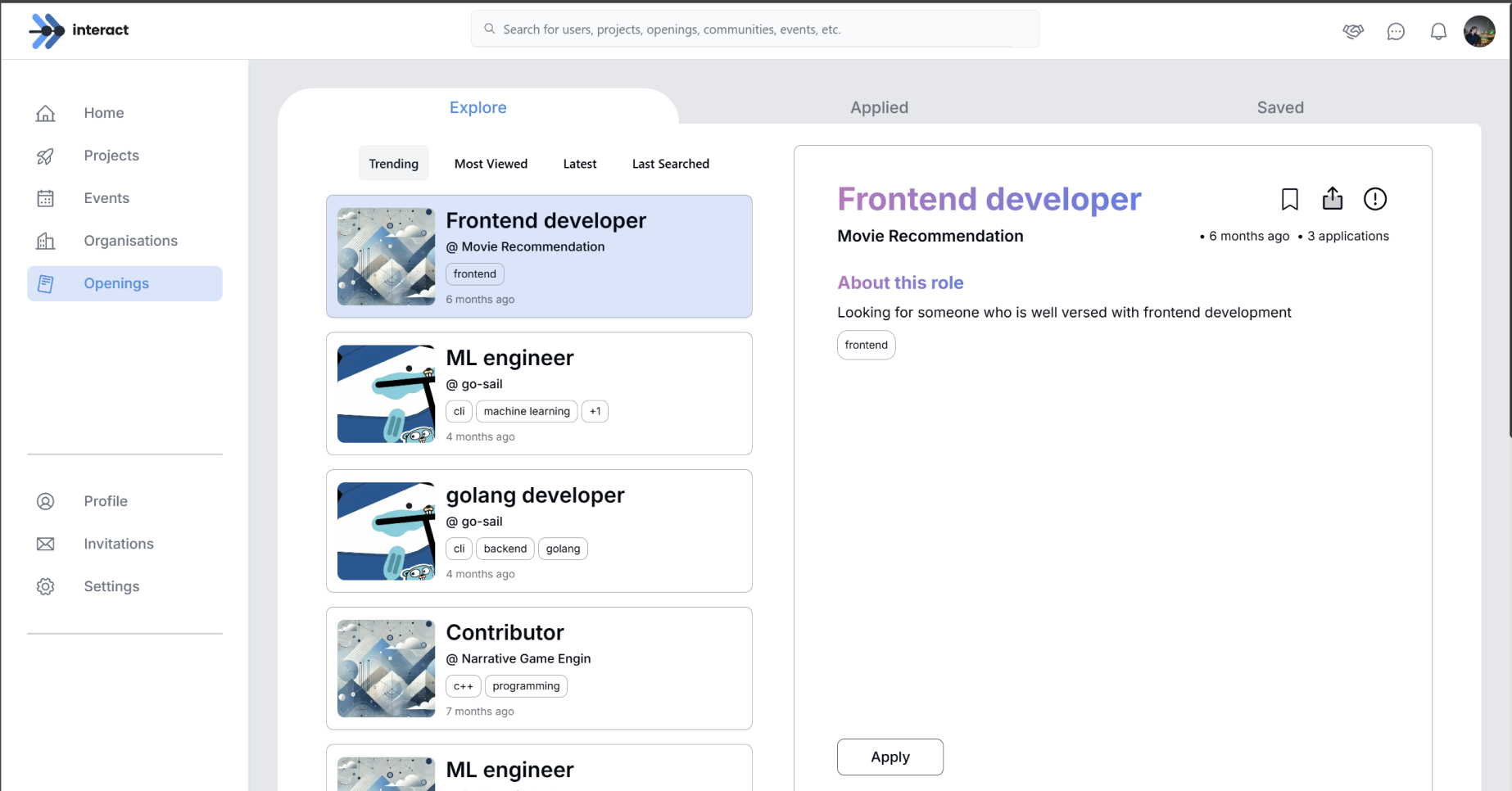 Interact V3 Website - the scope had grown, and so had the ambition
Around this time my involvement in CSI and VIT's technical team was deepening and I was seeing the same coordination problems at an organisational level. Clubs running their operations over WhatsApp. Announcements getting lost. No central place for a student to understand which clubs were active, what they were working on, or whether they were actually worth joining. So the scope grew again, deliberately. Organisation accounts, member management, club level projects, anonymous reviews, short lived announcements. The thinking had shifted: if Interact was going to be where collaboration happened, it needed to be where students already were for everything else. The collaboration was the goal. Everything around it was what made people show up.
By this point I had been building for months and had never deployed to a single real user. And then came the winter break of third year. Most of my friends were interning at companies I had not applied to, partly because I was planning for a masters, partly because I had made a quiet bet on Interact. It still hurt.
Watching people around you land things while you are spending your vacation building something nobody is using yet is a particular kind of lonely.
I decided that this break was do or die for Interact and threw myself into it completely.
But somewhere in the middle of all of it, the momentum started to drag. I had been living inside the same codebase for almost a year. Express and MongoDB had served their purpose but I had been meaning to shift to a relational database for a while and the refactor felt more exhausting than exciting. I needed something to make me want to open the laptop in the morning again. So one late night I decided to rewrite the entire backend in Go. Not because a technical document told me to. Not because it was the obvious right call. Because I needed a new challenge to keep going. I spent that night learning Go from YouTube and Stack Overflow and by morning I had the basic structure down. In two to three days the entire backend was shifted to Go and Postgres. The rewrite gave me back the energy the grind had taken.
By the end of the break I had a fully revamped UI, the entire organisation features built out, club management, member hierarchies, anonymous reviews, announcements, and a messaging feature built on a raw WebSockets server I wrote from scratch in Go without any libraries. The platform was starting to feel like something real.
I took on internships at Dyte and Fampay through early 2024. What I did not expect was how Interact would show up in those conversations. Recruiters would see it on my resume, an end to end platform built solo, multiple microservices, every architectural decision made and owned by one person, and the interviews would open up in a way I had not anticipated. No users, no metrics, but the act of having built something real from nothing was its own signal. It was the first time someone from outside my college looked at Interact and told me, without saying it directly, that it mattered. Interact slowed down during the internships but did not stop. I brought in a few junior developers, framed it as a learning opportunity, and finally deployed in February 2024. Real users, real feedback, for the first time. The team was small and transient because it was unpaid and you can only sell the idea of learning for so long. But the product was live and something was shifting.
The rise
July 2024. Fourth year starting, internships done. By the end of my time at Fam I had realised I could not give Interact and my research work (for masters) what they needed while also holding down an internship, so I made the call to step back and focus. Another safe option walked away from. Another bet placed on the thing I had been building for two years.
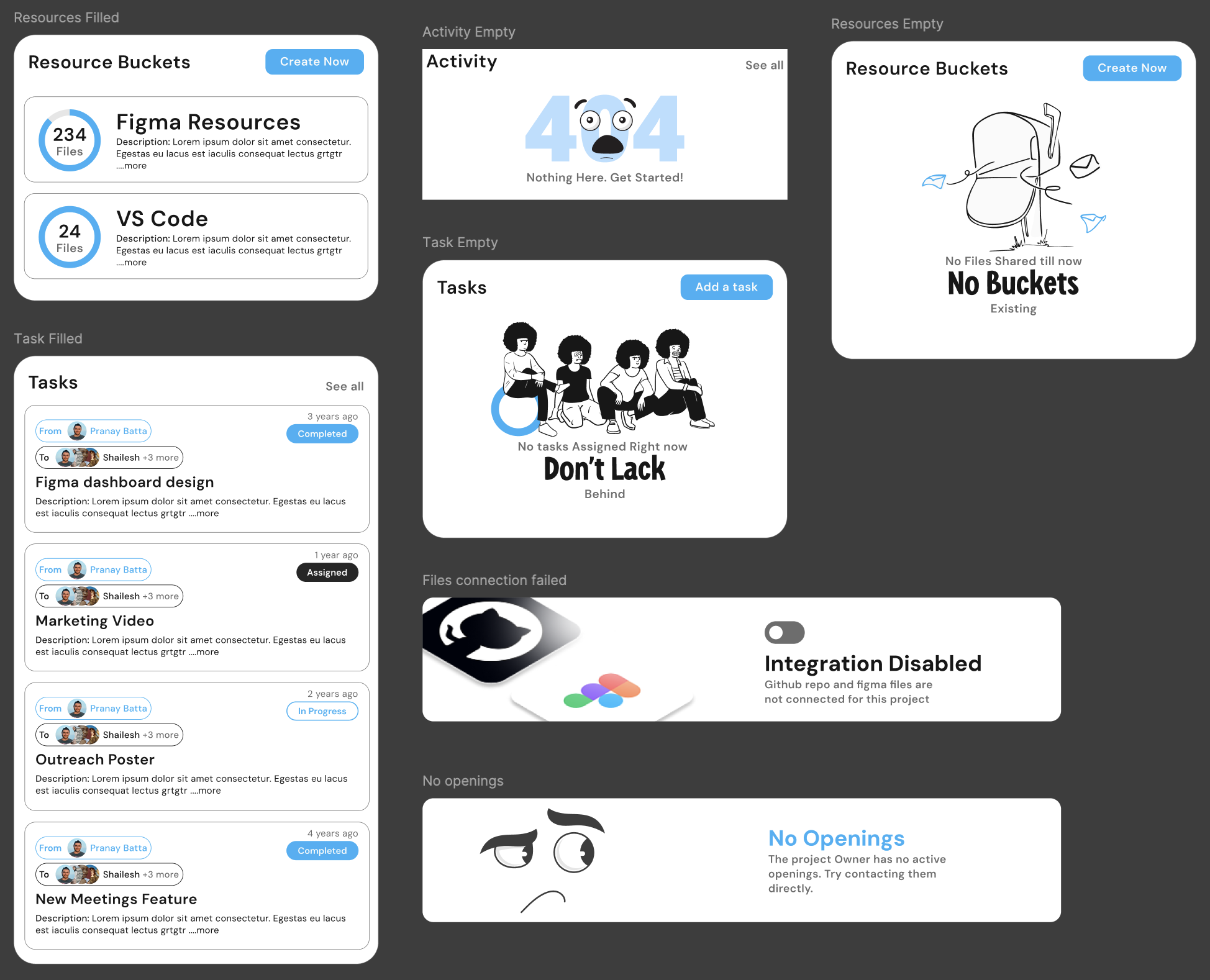 Interact Mid 2024 - everything built, nobody there yet
The product was live but barely active. Tech was never the problem anymore. What Interact needed was distribution and for that I needed a team across more than just engineering. I started bringing people in across product, marketing, design and outreach. By September we were around ten people working across domains and for the first time I was watching people make reels about something I had built, think through product strategy, push features. It felt surreal in the best way.
That same month, many hackathons were being planned as part of a large technical initiative at VIT. I saw an opportunity to get Interact in front of a real audience and pitched the idea of running all of them on the platform. Built in team formation, dashboards, task management, leaderboards, judging, all of it inside Interact. The college authorities liked it. What happened next I was not prepared for.
A Smart India Hackathon internal selection round was happening on the 12th of September. They wanted to use Interact for it. The pitch had been made on the 9th. The feature was not built. I had three days, two or three junior developers who had classes and could not contribute full time, and a hackathon that was high stakes with almost zero margin for error. No Claude Code, no Copilot, no coding assistant of any kind. Just a text editor, documentation, and whatever I could hold in my head at once. I spent those days heads down, barely sleeping, building the entire judging and scoring flow from scratch. The morning of the event we were supposed to give a walkthrough to the administrators and student participants.
Five minutes before that walkthrough I was still pushing code.
My teammates, who were handling the presentation, saw the platform for the first time while explaining it to a room full of people.
The next day was the hackathon. The first real test of the judging flow was in production, live, with a 1000+ participants and actual judges scoring actual teams. Nothing broke. It was nowhere close to smooth but it held together and by the end of it everything had gone through without a failure. That moment cracked something open. Five to six clubs signed on to use Interact for the larger set of hackathons happening later that month. The platform had a reputation now, even if a small one.
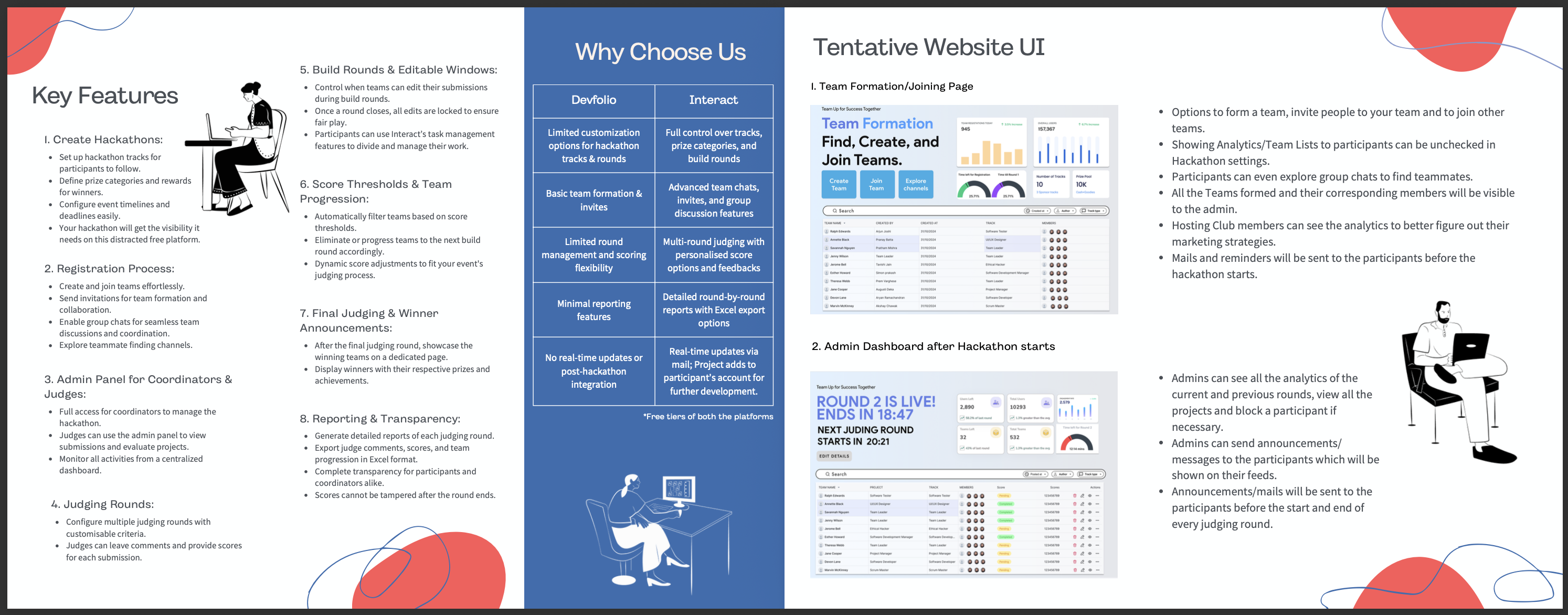 Interact hackathons brochure - what we put out when the hackathon vertical became real
The real inflection point came in January 2025. Yantra'25, VIT's largest technical fest, with 40+ events running in parallel, was going to happen in February. I had around twenty days. We did a full UI and UX overhaul, the third major redesign of Interact's life, ran beta tests with real students, coordinated 50+ volunteers across every event, and built out a proper escalation hierarchy so that if something went wrong on the ground there was always someone to call.
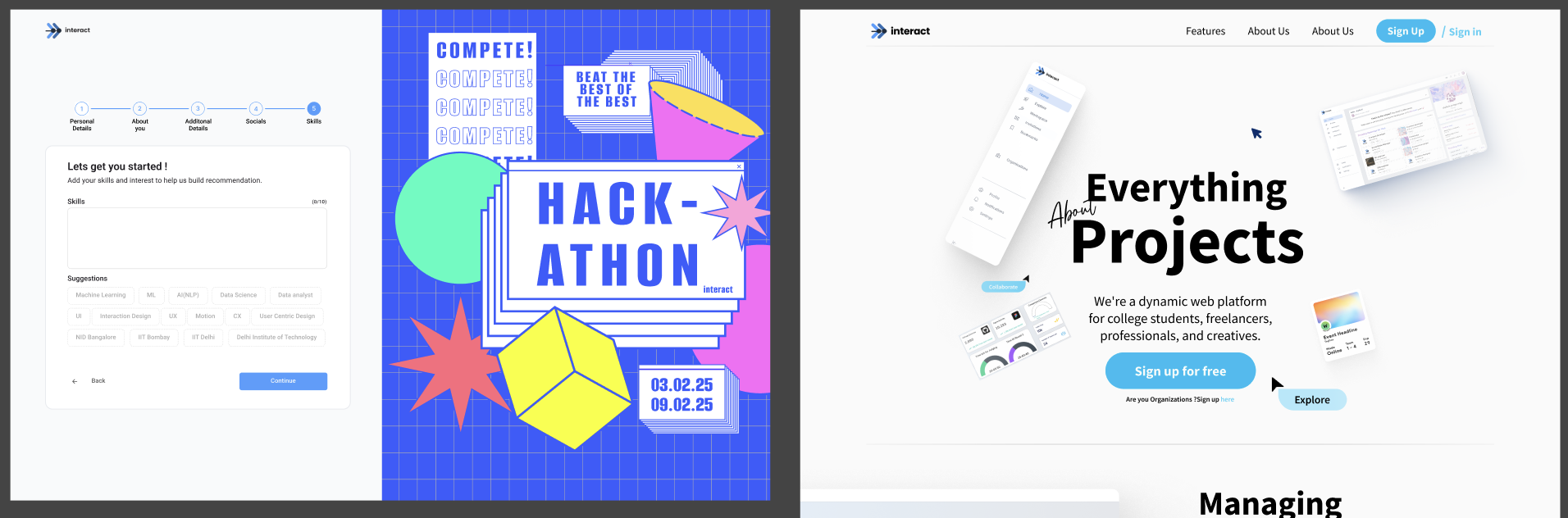 Interact landing page at peak - this is what 7,000 users saw
Yantra ran entirely on Interact. In the week that followed, Interact served over 100,000 requests. 7,000 active users were on the platform. Clubs were managing their organisations on it. Students were using the projects and collaboration features the platform had always been built around. Everything the product was supposed to be was finally, visibly, actually there.
And then, my college began early conversations about using Interact as the official platform for research collaborations between professors and students. The ceiling was still rising.
Letting it go
And then I shut it down. Not in a dramatic moment. Not after a big fight or a failed fundraise. Just a slow, honest reckoning with a few things that had been true for a while and that I had been too close to see clearly.
The first was the business reality. Interact's users were college students. That was the whole point. But students are one of the hardest user bases to build a sustainable business around. You cannot charge them meaningfully. Sponsorships and institutional deals were possible but slow and uncertain, and every monetisation path I could see required a level of time and focus that I no longer had. I had joined Maxim in March 2025 and Bifrost was consuming everything. Interact needed someone fully present and I could not be that person anymore.
The second was harder to admit. Even at peak, even with 7,000 users and clubs and the conversations of making it the official platform and the 100K requests in a week, Interact got a perception problem we tried to avoid but couldn't. The hackathon pipeline that gave us our biggest growth also gave us our biggest constraint. Students thought of Interact as a hackathon platform. That was not what it was built to be. We tried to correct it but the narrative had already settled and shifting it would have required a sustained marketing effort from a team that was running on goodwill and motivation alone.
The third was the most personal. I had been building Interact for three years. It had taught me everything: how to manage a distributed system, how to write production Go, how WebRTC and WebSockets actually work under pressure, how to coordinate a team of 50 people across an event, how to make product decisions with incomplete information. The learning, which was always part of why I kept going, had compounded into something I could feel in how I worked every single day. But the role Interact had to play in my journey felt complete. Continuing would have meant running something I could not give enough to, for users who deserved better than a half present founder.
What it left behind
There is a line I keep coming back to when I think about Interact and Bifrost in the same breath. Not a technical one. More of a feeling. When I was building Bifrost, the fastest LLM gateway in the world, shipped at Maxim, there were moments where the engineering decisions came quickly and naturally. How to think about load at scale. How to architect something that needs to be reliable under pressure. How to hold the whole system in your head while shipping fast. I do not think those instincts came from reading about distributed systems. I think they came from three years of building Interact, from managing 100K requests in a week on infrastructure I had set up myself, from shipping a judging system to production without testing it, from rewriting an entire backend in Go in two days because I needed to feel alive in the work again.
Bifrost is a different product in a different world. But the engineer who built it was shaped almost entirely by Interact.
“The problem Interact was built to solve still exists. Right now, somewhere in a college campus, a student with a half finished project is asking around manually, burning time, hoping someone in their limited network happens to be available and interested. The collaboration layer for college students, a real one, not a LinkedIn or a WhatsApp group, has never been built properly. Interact got close. Someone should finish what it started.
If that someone is you, my work is on this site and so is every way to reach me. The Instagram page for Interact, with everything we built and shipped and the community that showed up around it, is still up at interact.now. It is worth a look at what was there and what could still be.